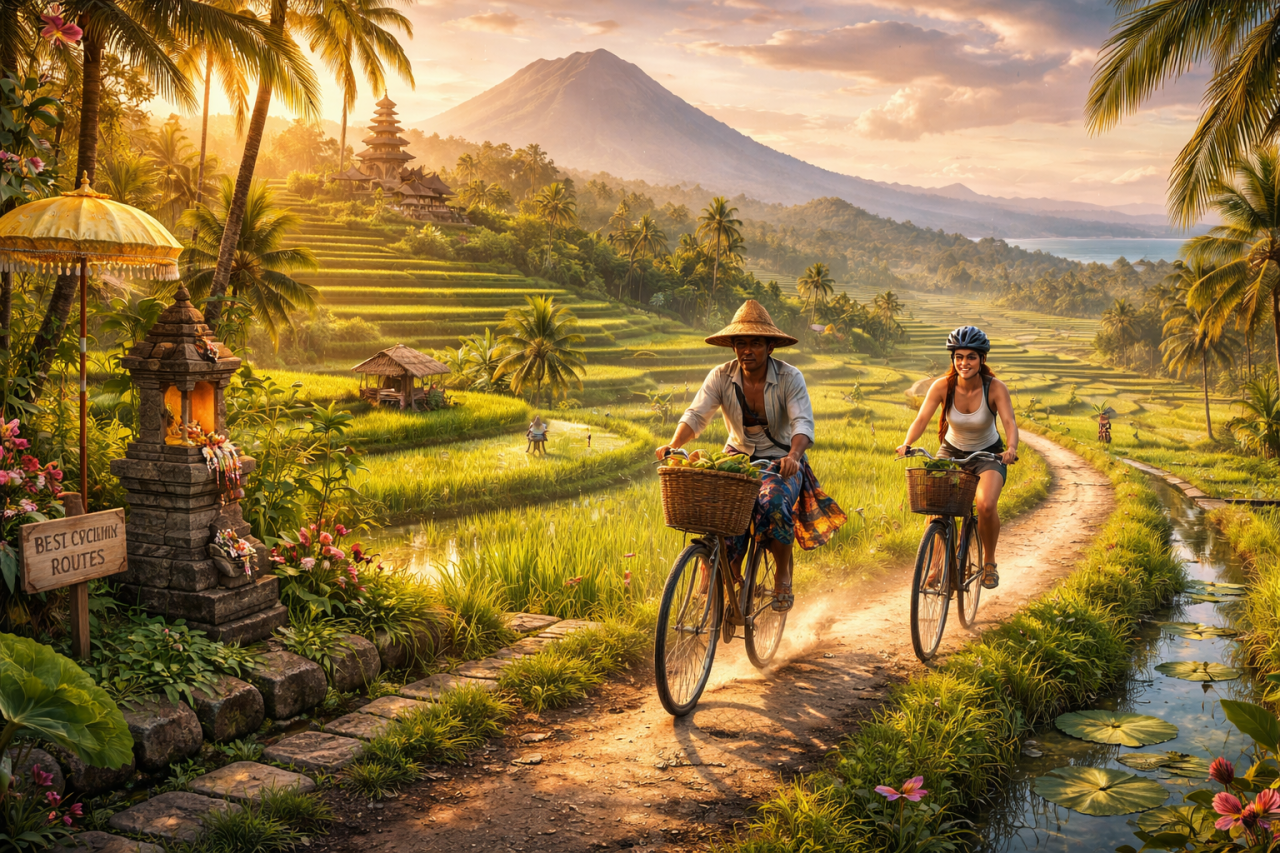
Bali’s rice terraces are a patchwork of emerald, lime, and gold, stitched together by narrow paths and shaded by palm silhouettes. For travelers craving slow movement and vivid scenes, cycling through Bali’s rice fields is a sensory feast: the clack of pedal and chain, the scent of wet earth, and the sight of farmers bent beneath conical hats. This article—written in a Fenna-style voice with Dutch curiosity and playful observation—maps the best routes, practical tips, and local flavors for getting off the main road and into Bali’s green heart.
Why cycle rice fields in Bali?
Cycling lets you move at the perfect speed to notice tiny details: drain channels, temple shrines tucked among paddies, and children waving from farm tracks. It’s eco-friendly and intimate; you meet villagers, sample roadside snacks, and pause for those unmistakable photographs. For young, adventurous travelers who love authenticity, Bali’s rice-field rides deliver stories that last longer than selfies.
Best regions and routes
Below are several tried-and-true routes, from gentle morning rides to more challenging loops. Each option includes highlights, what to expect, and tips for planning your day.
Ubud — Campuhan Ridge to Tegallalang loop
- Highlights: Campuhan Ridge Walk views, Tegallalang Rice Terraces, artisan cafés, and yoga hubs.
- Route idea: Start in central Ubud, take the Campuhan Ridge Walk early to avoid crowds, then ride north toward Tegallalang for the iconic layered terraces.
- What to expect: A mix of paved and compact dirt roads, moderate climbs, and plenty of photo stops.
- Local tip: Visit a small warung (local café) near Tegallalang for fresh coconut water and banana fritters.
- How to find it: You can search for these places on Google Maps by typing: Campuhan Ridge Walk and Tegallalang Rice Terrace.
Jatiluwih — The UNESCO landscapes loop
- Highlights: Wide-open panoramas, classic subak irrigation systems, cooler air, and fewer tourists.
- Route idea: Start at the Jatiluwih viewpoints and pedal the ridge roads that sweep around the terraces for several kilometers.
- What to expect: Longer distances and rolling hills; best for riders comfortable with steady climbs.
- Local tip: Time your ride for late afternoon; the light slants beautifully over the terraces.
- How to find it: You can search for it on Google Maps by typing: Jatiluwih Rice Terraces.
Sidemen — Quiet paddies and village life
- Highlights: Intimate village lanes, Mount Agung vistas, traditional weaving villages.
- Route idea: Use Sidemen as a base and cycle the looped paths through adjacent rice fields, stopping at local weavers.
- What to expect: Narrow lanes, encounters with farmers, and authentic rural atmospheres.
- Local tip: Bring small change to buy steamed cassava or snacks from roadside stalls.
- How to find it: You can search for it on Google Maps by typing: Sidemen, Bali.
Tabanan — Batu Karu & Seseh coastal paddy rides
- Highlights: Rice fields that meet the sea, dramatic volcano backdrops, black-sand beaches nearby.
- Route idea: Explore the paddies north of Tabanan town and continue toward Seseh or Batu Karu for coastal views.
- What to expect: Flat to gentle roads, fewer tourist facilities, and spectacular sunsets near the coast.
- Local tip: Stop at a local warung for grilled fish when you hit the beach.
- How to find it: You can search for it on Google Maps by typing: Tabanan Regency and Seseh Beach.
Jembrana — West Bali’s green hinterlands
- Highlights: Less-visited landscapes, wide terraces, and proximity to traditional ceremonies.
- Route idea: Cycle between small villages and rice paddies; combine with a visit to local markets.
- What to expect: Truly off-the-beaten-path riding with friendly local encounters.
- Local tip: Bring sunscreen and a hat—services can be sparse here.
- How to find it: You can search for it on Google Maps by typing: Jembrana Regency, Bali.
Practical planning and safety
- Best time to ride: Early morning (6–9 AM) or late afternoon (3–6 PM) to avoid midday heat and capture the best light for photos.
- Season note: Bali’s dry season (April–October) is ideal for cycling. The wet season brings slippery tracks and occasional flooding in low-lying paddies.
- Bike choice: A hybrid or gravel bike with puncture-resistant tires is perfect. Electric-assist bikes are a great option for uphill stretches and longer routes.
- Rentals and guides: Ubud and Canggu have several rental shops and guided-cycle operators. Ask for a helmet, spare tube, and a basic repair kit.
- Respect local customs: Always slow down near temples and shrines. Dress modestly when entering village compounds—shoulders and knees covered are appreciated.
- Hydration and snacks: Water, electrolytes, and portable snacks (bananas, peanuts) will keep energy up during long loops.
Cultural highlights to notice on the ride
- Subak irrigation systems: The centuries-old cooperative water-management system is a glimpse into Bali’s communal life and agricultural wisdom.
- Temple shrines in paddies: Small bale and shrine structures can sit in the middle of fields—pause and observe respectfully.
- Balinese rice lifecycle: Depending on the season you’ll see neon green seedlings, flooded mirror-like paddies, or golden harvest fields. Each phase is photogenic in its own way.
Recommended stops — cafes, viewpoints, and local experiences
- Warung Ibu Oka (for local flavors in Ubud area): You can search for it on Google Maps by typing: Warung Ibu Oka. Try local snacks at roadside stalls too.
- Tegallalang Rice Terrace viewpoints: You can search for it on Google Maps by typing: Tegallalang Rice Terrace.
- Local weaving cooperatives in Sidemen: You can search for it on Google Maps by typing: Sidemen Weaving Village.
- Jatiluwih viewpoint platforms: You can search for it on Google Maps by typing: Jatiluwih Rice Terraces.
Photography and storytelling tips (Fenna-style)
- Golden-hour magic: The hour after sunrise and before sunset turns paddies into liquid gold— pedal slowly and set up shots with foreground interest like a farmer or rice bundles.
- Dutch perspective: Notice shared agrarian values—how community irrigation resembles Dutch polder cooperation. Mention this connection to give readers a resonant cultural frame.
- Candid village moments: Respectfully ask before photographing people. A few exchanged words, a smile, or a small purchase opens doors for more authentic portraits.
Sample itineraries
- Half-day Ubud loop: Start at 7 AM, Campuhan Ridge Walk, north to Tegallalang, coffee break, return via small lanes—easy pace, 2–3 hours.
- Full-day Jatiluwih adventure: Start early, climb to the viewpoints, explore the terraces, lunch at a local warung, finish with a scenic descent—4–6 hours.
- Sidemen cultural ride: Morning ride through paddies, visit a weaver’s cooperative, afternoon rice-harvest observation—ideal for a relaxed day with cultural depth.
Sustainability and etiquette
- Leave no trace: Carry out all plastic waste; be especially careful around water channels.
- Support locals: Buy snacks, pay small entrance fees, and tip guides. Even modest purchases support village economies.
- Bikes and paths: Stick to existing tracks. Riding across young seedlings can damage a farmer’s work and livelihood.
Final thoughts
Cycling Bali’s rice fields is one of those travel experiences that slow you down and reward you with quiet revelations. The routes above balance epic vistas and human-scale details—perfect for the adventurous, camera-toting traveler with a Dutch appetite for communal stories. Pack a light rain jacket, a sense of curiosity, and an empty memory card: Bali’s terraces are ready to be discovered, one pedal stroke at a time.
You can search for any of the places mentioned on Google Maps by typing the place name as listed above. Safe travels and happy cycling—Selamat jalan!

Comments (0)
There are no comments here yet, you can be the first!