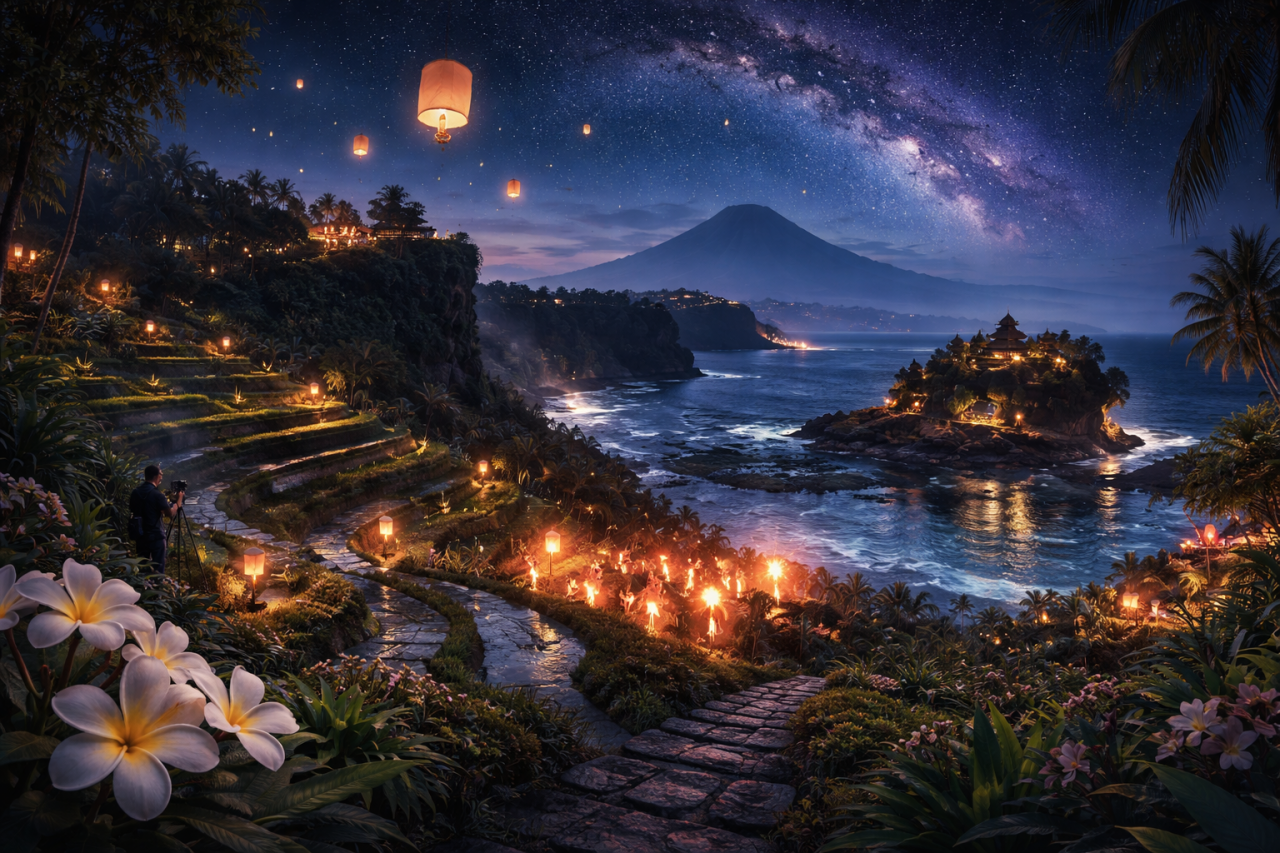
Bali at night is a tapestry of soft lantern light, distant temple silhouettes, and the slow pulse of the Indian Ocean. Like a Turkmen poet watching stars over the Karakum, a photographer in Bali learns to read the quiet geometry of night: temple spires, coconut palms, and fishing boats all become calligraphic strokes against a dark canvas. Below are the island’s most evocative locations for night photography, each described with practical tips, cultural notes, and a few proverbs to frame your view—because as an old Turkmen saying goes, “The night listens to the stories of travelers.”
Uluwatu Temple (Pura Luhur Uluwatu)
Perched on a clifftop in Bali’s southern peninsula, Pura Luhur Uluwatu offers dramatic sunset fades into night where temple silhouettes and waves meet. The temple’s cliff-edge location lets you shoot long exposures of the ocean with the temple’s meru towers as foreground interest.
Tips:
– Arrive before sunset to secure a vantage point and capture the changing light.
– Use a polarizing filter earlier in the evening and switch to long exposures once the light fades.
– You can search for it on Google Maps by typing: Pura Luhur Uluwatu
Cultural note:
– Respect temple hours and dress codes; cover shoulders and knees. A thoughtful photographer honors the space as both sacred and photographic subject.
Tanah Lot Temple (Pura Tanah Lot)
Tanah Lot sits on a rocky outcrop surrounded by waves, and at night the temple becomes a moody silhouette perfect for long-exposure seascapes and star trails when skies are clear. The interplay of tidal reflections and rock pools can create compelling foreground textures.
Shooting suggestions:
– Low tide reveals pools and wet sand that reflect lights; plan your shoot around tide charts.
– Try foreground bokeh with distant lights of the mainland or nearby warungs (small eateries).
– You can search for it on Google Maps by typing: Pura Tanah Lot
Proverb:
– “A silent night reveals the true shape of things,” a reminder to move slowly and let the scene unfold.
Seminyak Beach and Double Six Beach (Pantai Seminyak, Pantai Double Six)
Seminyak’s coastline blends beach clubs and black-sand stretches where neon reflections and gentle waves create cinematic scenes. After sunset, beachfront cafes and lantern-lit walkways provide varied light temperatures to play with.
What to capture:
– Silhouettes of sunbeds and umbrellas against residual twilight.
– Colorful bokeh from beach club lights for moody portraits.
– You can search for it on Google Maps by typing: Pantai Seminyak or Pantai Double Six (Seminyak)
Cultural note:
– Many beach clubs operate late; ask permission before photographing patrons or private venues.
Jimbaran Bay (Pantai Jimbaran)
Known for seafood dinners on the shore, Jimbaran Bay glows with candlelit tables and fishermen’s lamps. Night photography here can juxtapose intimate human scenes with the ocean’s vastness.
Practical tips:
– Capture slow-shutter exposures of candlelight to convey warmth without overexposing.
– Use a fast prime lens for low-light portraits of local vendors and diners.
– You can search for it on Google Maps by typing: Pantai Jimbaran
Anecdote:
– Like the Turkmen tradition of sharing bread, Jimbaran’s communal tables invite photographers to record moments of hospitality as well as landscape.
Sanur Beach (Pantai Sanur)
Sanur’s long seawall and calm waters give photographers clean horizons ideal for star trails and light-painting. The promenade lights are subtle, allowing for clearer night skies.
Technique:
– Find a stretch of the seawall for uninterrupted foreground lines.
– Combine star-trail stacks with low-level lighting for balanced compositions.
– You can search for it on Google Maps by typing: Pantai Sanur
Cultural note:
– Sanur has a quieter rhythm than the western beaches—perfect for contemplative night shoots.
Mount Batur Lookouts (Gunung Batur area)
While primarily famous for sunrise treks, some viewpoints around Mount Batur offer night-sky opportunities before dawn. The silhouette of the caldera and Mount Agung beyond can form dramatic layers against the Milky Way.
Shooting advice:
– Check moon phases: new moon nights are best for astrophotography.
– Bring warm clothes and a headlamp with a red mode to preserve night vision.
– You can search for it on Google Maps by typing: Gunung Batur
Proverb:
– “The mountain keeps its own counsel,” meaning patience yields the best skyward rewards.
Ubud’s Monkey Forest and Ubud Palace by Night (Mandala Suci Wenara Wana, Puri Saren Agung)
Ubud’s cultural center glows with subtle lamps and cultural performances. The Sacred Monkey Forest (Mandala Suci Wenara Wana) closes at dusk, but its vicinity and Ubud Palace (Puri Saren Agung) host evening dances and ambient light perfect for low-light cultural photography.
Ethical reminder:
– Always seek permission before photographing performances or close-ups of people.
– You can search for it on Google Maps by typing: Mandala Suci Wenara Wana (Sacred Monkey Forest) and Puri Saren Agung (Ubud Palace)
Storytelling tip:
– Capture the interplay between shadow and costume detail during Balinese dances for narrative richness.
Nusa Dua and Benoa Harbor (Nusa Dua Beachfront, Benoa Harbour)
Nusa Dua’s manicured beachfronts and Benoa’s harbor lights make for polished reflections and placid water compositions. Harbors can produce wonderful compositions of moored boats and light trails.
Best practices:
– Use a tripod and neutral density filters for long-exposure water smoothing.
– Shoot from jetties or promenades to include leading lines.
– You can search for it on Google Maps by typing: Nusa Dua Beach or Benoa Harbour
Cultural note:
– Harbors are working spaces—respect any restricted areas and stay safe near jetties.
Candid Nightlife in Kuta and Legian (Kuta Beach, Legian)
Kuta and Legian buzz after dark with neon signs, street performers, and vibrant markets. Night photography here is about energy, motion blur, and human stories.
Composition ideas:
– Pan with motorbikes to create motion streaks and keep ambient neon for color contrast.
– Street portraits capture the warmth and chaos of Bali’s evening economy.
– You can search for it on Google Maps by typing: Kuta Beach or Legian Beach
Proverb:
– “Where the village lights burn bright, the road learns new songs.” This honors the living, shifting nature of nightlife.
Technical Gear and Settings
Essentials:
– Sturdy tripod, remote shutter or intervalometer, headlamp with red light.
– Fast prime (35mm or 50mm f/1.8) and a wide-angle (14–24mm) for landscapes and star work.
– Spare batteries and memory cards—Bali’s humidity can shorten battery life.
Basic settings to start:
– For long-exposure seascapes: 10–30 seconds, ISO 100–400, f/8–f/16 for starburst lights.
– For low-light portraits and street scenes: 1/30–1/125s, ISO 800–3200, widest aperture.
– For star trails: multiple 20–30s exposures stacked, or one very long exposure depending on technique.
Cultural Respect and Practical Etiquette
Always ask permission where people, ceremonies, or private businesses are involved. Balinese culture is rich with ritual—photographing a temple offering without consent can be intrusive. Carry a sarong and sash for temple visits, and remember that a kind greeting opens doors to both hospitality and better images.
Proverb:
– “A respectful step makes the road easier,” which applies to both travel and photography.
Final Framing Thoughts
Night photography in Bali is an invitation to slow down and listen—to waves, temple bells, and distant laughter at warungs. Each frame can be a small bridge between worlds: the photographer’s eye, Balinese ritual, and echoes of your own homeland’s proverbs. As you travel the island after dusk, think of the photo as a shared bowl of pilaf—nourishing, communal, and best enjoyed with gratitude.
For each place above, you can search for it on Google Maps by typing the full place name provided in the section. Safe travels and clear skies: may your shutter capture the hush and the heartbeat of Bali at night.

Comments (0)
There are no comments here yet, you can be the first!